Tuesday, July 30, 2013

Mexican Fiesta

Arch of red, white, green
Drinks with layers of color
Welcome us inside

Mariachi band
A Mexican fiesta
Great food awaits us

Salads of all sorts
While entertainment begins
Delighting the crowd

Few Americans
Many Mexicans present
A night of culture

Five hundred years back
Aztec dancers entertain
Flashy, bright costumes

Time for the main course
Tamales, rice, beans, fish, beef
So many choices

To the crowd’s delight
A young singer emerges
Lovely with talent

We gringos just smile
While Mexicans sing along
To songs they know well

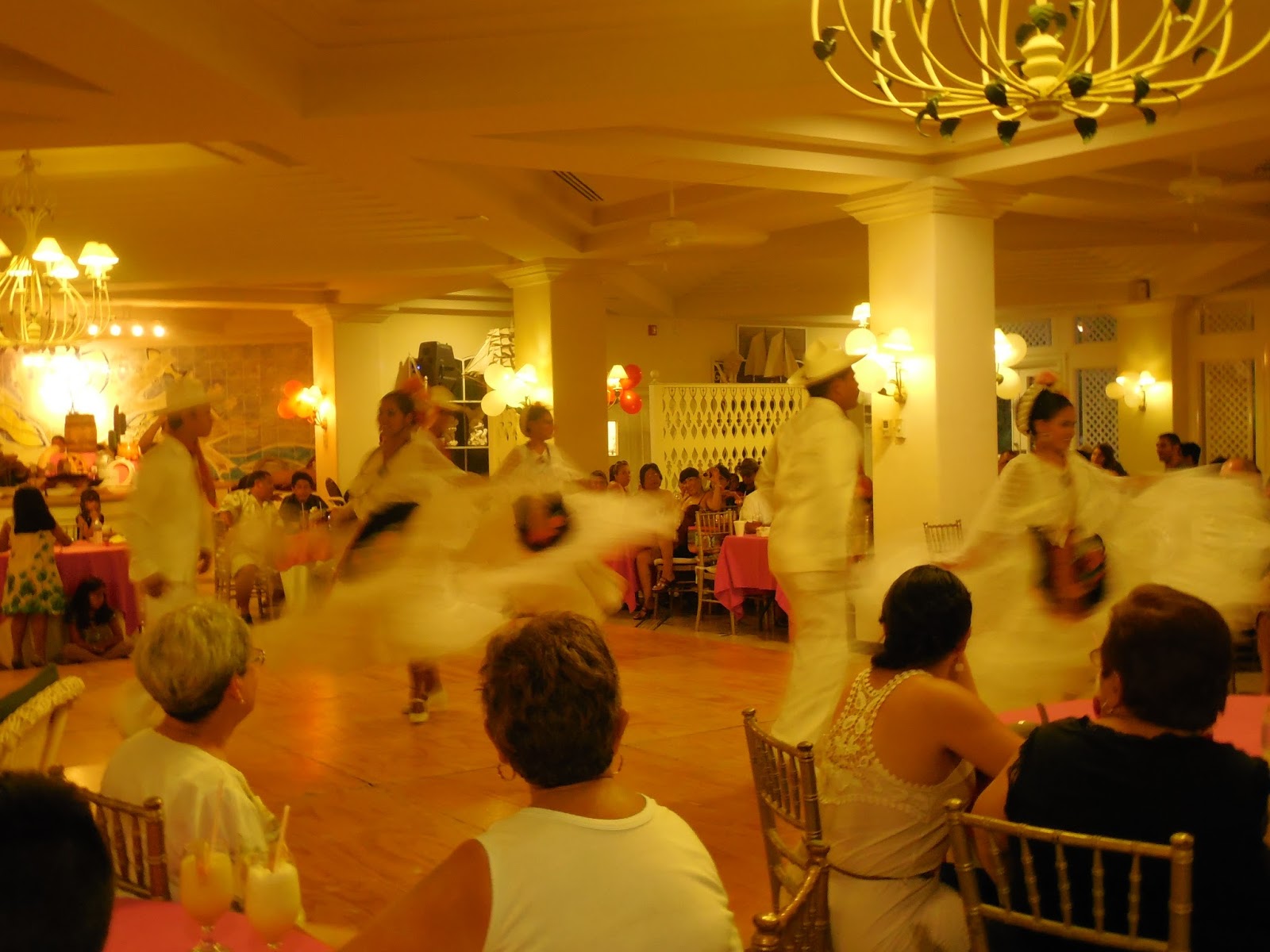
The dancers return
In costumes from Veracruz
Six dancers in all

Their feet move quickly
And colors swirl in turning
Bright smiling faces

While costumes are changed
The announcer leads contests
We laugh at the kids

Dessert bar is next
Cakes, churros, plantains, and flan
My plate is too small

More dances are shared
From all over Mexico
Colorful costumes

The party now ends
Celebrants full and happy
Smiling as they leave


Written on 7/24/2013


Monday, July 29, 2013

Experiencing Matzatlan

On our second full day in Matzatlan, we decided it was a good day to go downtown.  After riding the shuttle to the downtown resort, we found a cab to take us to the old part of Matzatlan.  These cabs are really more like big golf carts with back seats, a top, a windshield and with the sides open to the air—natural air-conditioning which felt great on a warm, humid day.  Matzatlan is more spread out than we had realized; it was another 5 miles or so to our destination.  We drove along a beautiful stretch of beach with a walkway.  The surf was great to look at but too dangerous for swimming.  Our driver, Jorge, provided bits of tourist information as we rode; when he dropped us off at the Cathedral we found out that he also does tours for $20.  The inside of the Cathedral is ornate.  I tried to be discreet in my photo-taking (no flash) so as not to disturb anybody praying.  I think I could have sat there for a while in that peaceful, holy setting, so full of history.  I was able to read bits of the writings on the wall, but my Spanish is limited.

Our friend took us through a modern department store (with AC!) to show us that it looks just like one in the U.S.  From there we walked to the busy marketplace where you could buy tourist trinkets, clothing, jewelry, food and drink, raw meat, chicken, and fish.  What a contrast.  The colors and smells awakened my senses.  I am a pin collector but had no luck finding one.  I did not know the Spanish word for pin which might have helped.  I did find a purple Matzatlan T-shirt.

We walked through the old streets, visiting the Opera House and museum.  We enjoyed beer and chips with guacamole at an outside table at a restaurant next to a square with a gazebo.  Finally, we caught a cab to another part of town.  Our friend took us to a shop with a myriad of delightful items—I bought a bowl, small dish, and an ornament.  When you go shopping with two men, you have to make choices fairly quickly, especially when the next stop is food.

Don took us to Pancho’s, a good restaurant overlooking the beach, one with which he was familiar.  My shrimp fajita was tasty and filling plus the breeze through the open window was refreshing.  We watched people playing on the beach, vendors, parasailers, and sailboats.  I took photos of it all, including some of the beautiful tiles inside the restaurant.  After a while we caught a cab and then a shuttle back to the resort.  We took a dip in the pool to cool off and watched the sun set, painting the sky with hues of orange and pink.  Another day in Matzatlan had come to an end.

Written on 7/24/2013


Adjusting to Humidity

I wake up in the morning and I am sticky.  This is despite the fact that the suite has AC and I showered the night before.  For the past 30 years I have lived in a desert climate.  Recently the humidity there actually doubled—it went from 3% to 6%.  Yeah, it’s dry.  When the humidity surpasses 20% people start complaining that it’s muggy.  Matzatlan weather, with 55% humidity, is a bit of a change for us.

Since we are at the height of the Mexican tourist season, it seems that the resort doesn’t worry so much if the shuttle buses have AC.  With the coastal breezes, I’m sure that Matzatlan is much more comfortable than where these vacationers came from.  I look at the Mexicans on the bus with me and I wonder if they are as wet and sticky as I am.  Do their bodies adjust or are they simply used to it?

And then there’s the hair issue.  Mexican hair is much thicker than mine.  Most women seem to keep theirs long, often putting it up.  I look at my fine, short hair in the mirror and notice that it’s developed a new style.  No amount of effort with the curling iron can convince it to stay near my head.  I can “fix” it and within minutes it is doing its own thing again.  The sides and the back wave, sticking straight out, and my bangs curl.  At least it’s somewhat symmetrical.  I have given up.

I am learning that the best way to deal with the humidity is to take frequent dips in the pool.  It works quite well.  I think I could get used to this. . .

Written on 7/23/2013


First Days in Matzatlan


It is my second night in Matzatlan, Mexico, and I am sitting on our little balcony overlooking the ocean.  Soothing guitar and flute music floats through the night air.  The happy sound of people playing in the pools below is mixed with the pounding of the surf.  I have chosen the open patio over the air-conditioned suite even though I am rather hot and sticky.  I want to absorb it all.

This is my first time in Mexico.  We were invited to join my husband’s friend, Don, in his timeshare and we eagerly accepted.  We arrived yesterday afternoon and were able to get into our place around 5:00 p.m.  We quickly changed into our bathing suits and headed down to one of several pools to cool off.  The water was actually too warm for swimming but it felt good just to get wet.  We were all so tired that we fell asleep for a while on the lounge chairs.  We ate dinner outside at one of the resort’s restaurants.

For our first full day we decided to take it easy.  Coffee, pastry, and a banana at the deli for breakfast.  We found three lounge chairs under an umbrella next to a pool and that’s where we hung out the rest of the day.  We’d take a dip in the pool to cool off then return to our lounge chairs to read or watch the people.  Attentive waiters were around to take orders.  I started with ice water then later ordered a beer, Negra Modelo, and a quesadilla for lunch.  Bob and I moved down to the beach for a while to enjoy the surf.  However, we were back to the pool in time for two for one cocktail hour.  The mango margaritas were sensational!  We chose to take the shuttle over to the resort’s other location in downtown Matzatlan.  We enjoyed dinner in their restaurant on the beach, serenaded by a mariachi band which was standing down below on the sand. 

We noticed that we really stand out here.  I feel very gringo y vieja.  The people at both resorts are mostly Mexican and younger than us—lots of families.  I had expected more Americans since the resort really caters to Americans.  While walking downtown we met a guy (selling something) who told us that we are at the height of the Mexican tourist season.  Americans don’t usually come until October or November when it’s cooler.  Perhaps this is why we didn’t get the air-conditioned shuttle—the natives are used to the weather.

Because we stand out, we are the target of salespeople, from jewelry vendors to timeshare salespeople—this is especially true for Bob.  He seems to draw them like a magnet and they don’t go away.  The problem is that he is friendly, asks questions, and doesn’t say no.  It’s not that he ever says yes, or intends to—he just doesn’t say no.  Don and I are working on him to change this.  He is already improving.


Written on 7/21/2013


Wednesday, July 10, 2013

Fourth of July with Mom and Dad


This past week my husband and I drove to Lake Tahoe to stay with my parents at their timeshare.  It had been a year and a half since I had seen them.  I was struck by how much my dad, now 86, has slowed down.  He now walks slowly, slightly bent over.  My dad was content to sit on the small deck and enjoy the trees.  We spent a lot of time just talking.  My mom’s goal for this trip was to see the fireworks over Lake Tahoe.  My dad was not so excited about this and kept suggesting that it might rain, much to my mom’s chagrin.  It is a half-mile from the resort to Nevada Beach, the prime spot to observe the fireworks.  My dad insisted that he would be able to walk there—I pointed out to my worried mom that we were carrying chairs so he could sit if necessary.

We joined a crowd of people walking down to the beach (the road had been blocked off earlier in the day).  My parents were by far the oldest people on that path, but they did just fine.  They walked at their own pace, hand in hand.  Bob and I walked ahead, periodically stopping and waiting.  A woman approached me and commented how sweet it was to see them holding hands and suggested that I take a picture from behind—I took her advice.

We arrived at the beach and found a great spot.  The fireworks were fantastic and my mom was happy.  My parents walked back up to the condo, once again holding hands.

My parents have been married 63 years—that’s long time.  I watch how they support each other now that they each have some health problems.  My mom watches my dad like a hawk; he mostly accepts it.  Their simple devotion to each other is touching.

The most important thing I learned from my parents is love.  It is not only their love for each other but the love for us as children.  My mom was always there for us and was more likely to express her love verbally.  My dad was not demonstrative, but we had no doubt that he’d give us the shirt off his back if necessary.  We never doubted that we were loved—we were secure in this.  They also demonstrated how to treat others with respect and took us to church where these values were reinforced.

My parents were not able to give us a lot of material things but that didn’t matter. We had something much more valuable—love.


Monday, May 20, 2013

It’s About Acceptance


This past Thursday I attended a vigil celebrating the International Day against Homophobia and Transphobia.  About forty people, LGBT and their straight supporters, listened attentively as the speakers shared their stories.  I was amazed at the deep, personal nature of these testimonies.  There were gay men, lesbians, a woman married to a gay man, a transsexual woman, her heterosexual wife, and a mother of a transsexual man.  A woman talked of homophobia—even her own homophobia and inability to accept herself.  They spoke of difficulties dealing with family members.  They talked about rejection.  These stories broke my heart—but there was also hope.  Attitudes are changing.  It is happening slowly in Idaho, but there are rays of hope.

Yesterday was Pentecost and also the second anniversary of my church’s decision to become a reconciling congregation, welcoming everybody.  A lesbian member gave a tearful testimony about why our church’s welcome is important to her.  She told of coming out to her friends at another church, only to be rejected by them all.  She said it meant a lot just to be able to hold her partner’s hand in church. During the pastor’s class after the service, we discussed this testimony and the sermon.  An older woman shared that she finally had the courage to walk into our LGBT support group, admitting to us that she is gay.  This took an incredible amount of courage and trust for her to come out to us.

As I ponder these two events, I wonder why this is such a big deal.  All of the people I mentioned are intelligent, articulate people.  Good people.  They are people worth knowing.  Why should anybody care who they love or what sex they were born?  What difference does it make?  Don’t we all just want to be loved and accepted?  Why is it so hard to offer that to others?  As a Christian, I am trying to reflect God’s love and accept others just as Jesus did.  For me, it is the only way to live.

Saturday, May 18, 2013

Digging in My Garden


Dark, warm earth slides through my fingers.  I carefully pat the dirt firmly around the small pepper plant then sit back to admire it.  The sun warms my shoulders and a breeze whips through my hair.  The sounds of bird calls surround me.  I am taking my time planting my garden—one of the luxuries of unemployment.  Each spring I briefly wonder if all of the work is worth it.  I’m not getting any younger and I could be doing other things.  But I would miss the feel of the dirt in my fingers, the anticipation of green shoots popping up through the ground, the sight of ripening vegetables, and the flavor—oh, the flavor!  There is nothing like vegetables freshly picked from the garden.  My favorite is the cherry tomatoes which almost taste like candy.  I pop them into my mouth as I work in the garden so most of them never make it into the house.  I would miss my time in the garden—the sun, the smells, the sights, the sounds, the textures. . . So here I am once again, looking forward to the fruits of my labor and appreciating my oneness with the natural world around me.


Friday, April 26, 2013

Job Market Dropout


A few weeks ago I listened to a story on NPR (National Public Radio) about the U.S. jobless rate.  The Labor Department reported that our nation’s unemployment rate moved down to 7.6 percent in March, the lowest rate in 4 years.  However, this is not the good news it would seem to be.  There were expectations for 200,000 net new jobs, but only 88,000 materialized.  So why did the jobless rate decline?  It declined because almost a half million people dropped out of the labor force.  That’s right—nearly 500,000 people stopped working or looking for work.

I understand this because several months ago I stopped looking for work, too.  Why?  Pure frustration and a feeling of hopelessness.  There aren’t many jobs in Idaho and a large number of the jobs we have are low paying.  (Idaho has the highest percentage of minimum wage jobs in the country.)  When I moved to Idaho nearly 30 years ago, I had left a job which paid the equivalent of $10 per hour—and that was not considered to be a particularly good wage.  All these years later I see many jobs, often requiring experience, advertised at that same wage or less.  The sad truth is that the majority of Idaho jobs do not pay a living wage.  I looked diligently for a job for over a year, sometimes coming very close.  At one of the last interviews that I had, I was told that I was in the top four out of 150 applicants.  I didn’t get the job—close, but not close enough.  I am fairly certain that my age is working against me, but I can’t prove it.  Of course, we could use the money.  We are living off my husband’s retirement while trying to help a daughter who has been struggling to make it and is now also unemployed.

I felt like I was beating my head against a wall to get a low-paying job that I didn’t really want.  Where are the good paying, interesting, challenging jobs?  Where are the jobs, period?  I remember reading that the definition of insanity is to continue to do the same thing and expect different results.

It was time to do something different—time to explore.  I decided to broaden my volunteer activities and make some commitments, something I couldn’t do while job hunting.  I have been helping in a political party office and soon I’ll be volunteering at the zoo.  I hope to find a project at the foodbank.  Of course, I continue to volunteer at my church.  Some people have suggested that I might find a job by volunteering, but, to be honest, my goal is to simply make a contribution to my community.

My second goal has been to stretch myself through classes and experimentation.  The creative side of me has been squelched for too long.  I have taken some classes on glass fusion—the colors are delightful and bring out an almost child-like joy in me.  I’m currently taking a class about drawing and painting from nature; we’re learning about using sketchbooks and journals.  I’m looking forward to going out and trying what I’ve learned.

Where will this lead me?  I don’t know at this point.  Perhaps I’ll attempt to re-enter the job market in another year—with a new point of view and perhaps some new skills.  Or perhaps I’ll decide I’m retired and find fulfillment entirely in volunteer work.  Perhaps I’ll become an artist.  Who knows?  In the meantime, I’ll be exploring.


Monday, April 22, 2013

Earth Day Reflection


On this Earth Day I think back to the earliest Earth days in the early 1970s.  We were so innocent then—innocent and ignorant.  I recall the Earth Day celebrations on the quad of my college campus—lots of music, tie-dyed shirts, and sun.  Recycling was just beginning.  My roommates and I collected aluminum cans.  It was a simple thing to do and it was one of the few things we could actually recycle.  This was the beginning of my recycling habit.

All these years later we know so much more about the threats to our environment.  I am not one of those people who approach environmental issues with an almost religious fervor.  I do appreciate those people who work to keep the rest of us aware.  However, I have never stopped recycling.  I don’t talk about it; I just do it.  It is so easy for us now.  So much of what we use can be recycled.  All we have to do is toss it into a special large container and it is picked up for us every other week.  We throw very little into the trash.  Why would we when recycling is so easy?  We are amazed at our neighbors who have overflowing trash cans.

Global warming is real; all climatologists agree on this.  It’s not a scientific uncertainty.  Look at the rate of the melting of the world’s glaciers.  Temperatures are rising worldwide and we are seeing more extreme storms causing massive damage.  Our oceans are rising.  Why the controversy?  It is greed pure and simple.  Corporations, which don’t tend to have a conscience, are all about making money.  They do not want to see environmental laws which interfere with their profits.  They hire lobbyists who buy politicians.  We must elect representatives who will vote to protect our environment.

As an individual, there are small things I can do.  Our public transportation system is rather limited here, but I do try to limit my driving by doing my errands on one or two days a week and in such a way that I’m not driving back and forth across town.  We mostly drive cars that get good gas mileage.  Yesterday, on a designated “green” Sunday, members of my church were encouraged to bike, walk or carpool to church.  A large number of people took up this challenge.  My husband and I made an 8-mile round trip bike ride that day.  We had a bit of an uphill climb to get there, but I’m thinking that we could do this other Sundays during nice weather.

What else can we do?  My husband, who does most of our grocery shopping, is very good about taking reusable bags with him when he goes to the grocery store.  We no longer buy bottled water, but drink from reusable plastic or metal bottles.  We rarely use pesticides on our property—I have found that these pests usually have natural predators that will take care of the problem for us if given a chance.  We don’t buy every new thing that comes along but make good use of what we have.   We use our belongings until they wear out.

Protection of the earth means caring for every living thing on it.  Species are going extinct at an alarming rate.  We need to work on preservation.  However, part of this process must involve the people who live in the affected area.  Hungry people are not going to care if a particular species of animal is dying off.  In some African countries, programs have been set up to provide eco-tours for foreign tourists.  This is a win-win situation because it provides income for local people and gives them an incentive for protecting their local animal species.

I think of those amazing photos of our planet taken by astronauts.  It is beautiful to behold.  Earth Day cannot just be celebrated just one day a year.  Earth Day should be every day.


Monday, April 15, 2013

Why?


Horror
Numbness
Why?
Words on the radio
No words
Why?
Joyful day
Turned tragic
Why?
Images
Of a familiar place
But so wrong
So violent
Why?
Survivors
From another tragedy
Running to heal
But hit again
Why?
Uniformed servants
Responded quickly
Battle scenes
Not Boston streets
Why?
Sirens
Ambulances
Blood
Horror
Why?
Yellow tape
Clues searched
City lockdown
Shock
An eerie silence
Settles over Boston
Why?


Monday, April 08, 2013

March on Hunger


Red shirts assembled
Worship centered on hunger
Sang praises to God

Walkers met outside
Umbrellas deflecting rain
Waiting to begin

We marched on hunger
Toward the Idaho Statehouse
Red shirts in light rain

The mood was upbeat
We stood at the Capitol
Hunger was discussed

Red ribbons were tied
To ropes that each person grasped
Then we walked and prayed

Prayers to end hunger
As we walked ‘round the Statehouse
Prayers for the hungry

We’re just beginning
The event lasts the whole month
This March on Hunger

Build an awareness
Of the causes of hunger
Collect lots of food

Plenty food exists
Problem is distribution,
Heartless politics

Red shirts organize
Work to end hunger worldwide
One step at a time


Monday, April 01, 2013

A Season of Nonviolence


At the beginning of Lent about 150 people in my church signed a pledge promising to monitor and work on limiting the violence in their daily lives.  I was one of those people.  Each of us took home a purple bracelet stamped with “A Season of Nonviolence” to remind us of our commitment.  Some people give up a favorite food for Lent—our sacrifice was to give up violence.

With this commitment we acknowledged that peace begins within us, our families, our faith communities, and beyond.  We agreed to show respect for ourselves and others in word and action.  We said we would communicate carefully, peacefully, and eliminate violence in our speech.  We would listen to others, especially to those with whom we disagree.  We pledged to apologize when we hurt others, and forgive those who hurt us.  We would respect and care for nature.  We said we would practice nonviolent recreation.  We pledged to be courageous and challenge violence in all forms.

There were those at my church who didn’t take the pledge—they simply couldn’t do it.  Some of the people who did said it was hard.  My pastor confessed that she had to give up one of her favorite TV shows, CSI, and switched to the cooking channel instead.  One 15-year-old boy took his pledge very seriously.  He switched from spring football to track.  He said that he liked the nonviolent approach—it made him feel much calmer.  This teenage boy was not only brave enough to tell his peers, who didn’t understand, but he also stated his view for TV cameras in an interview about our church project.

And me?  I found it a bit easier than some of my fellow members.  By nature I am a fairly quiet, nonviolent person.  I am not easily angered.  I don’t hit or throw things.  I seldom yell.  I don’t like violent TV shows or movies so I rarely watch them.  However, I became aware of how pervasive violence is in our society.  Threads of it run through our daily lives and we are oblivious.  While I did not have to switch my bracelet as often as others (we were to switch wrists each time we encountered violence), I found violence in both expected and unexpected places.

It is hard to listen to the news or read the paper without finding violence in it.  In fact, I would say it is impossible.  Our media knows that it sells and they highlight it.  I found it difficult to avoid this sort of violence.  I encountered a violent scene in an unexpected place—I attended a special dance show aimed at elementary students.  A local dance company performed excerpts from some of their recent dances.  I was surprised when they included a piece from a dance based on Shakespeare’s Titus Andronicus, a very violent play.  In this dance the queen was given a plate of something red, obviously bloody, which she stuffed into her mouth.  During the question and answer period, one child asked what she was eating.  The adult avoided answering and told the child to research it.  Another place where I encountered violence was at a church leadership conference that I attended with my pastor and a few others.  War-like language was used multiple times plus we were even shown a picture of Jesus holding an assault rifle.  Seriously?

To my dismay, I even caught myself a few times.  I lost my patience with my adult daughter and yelled at her over the phone—totally counter-productive.  While listening to a radio report about North Korea’s provocative threats against my country, I found myself wishing violence against those leaders.  I was ashamed.  During a conversation I was told something that totally frustrated me and “I could just shoot her” popped out of my mouth.  Oops.  Of course, I didn’t mean it.  Why did I say it?

Violence in all forms is woven through the fabric of our society.  It is so common that we often fail to notice it.  The first step in developing a more peaceful world is to notice the violence.  Peace begins from deep within us—from love and respect for others and the world around us.  As Mahatma Gandhi said, “Nonviolence is not a garment to be put on and off at will.  Its seat is in the heart, and it must be an inseparable part of our being.”  To achieve a nonviolent society, we must first learn to sit and listen to others so we may truly understand them.  Nonviolence requires commitment from all of us.  “Nonviolence is not inaction.  It is not discussion.  It is not for the timid or weak.  Nonviolence is hard work.  It is the willingness to sacrifice.  It is the patience to win.”  (Cesar Chavez)

Today is Easter Sunday, the end of Lent and my church’s “Season of Nonviolence.”  We were invited to place our purple bracelets into the offering plate.  I did so knowing that from now on I will be more aware of what I say and do.  I will strive to live with love and peace in my heart, and try to summon the courage to speak out against violence and for justice in our world.  Nonviolence begins with the individual.  It begins with me.

3/31/2013

Friday, March 29, 2013

Good Friday Observed


Nailed to a cross
Mocked by men
Abandoned?
Three women watch nearby
Cling to each other
Agony
He speaks to them
Take care of each other
Love
Wine is offered on a cloth
He takes his last breath
Finished
The sky turns black
Temple curtain tears
Despair

Candles light a darkened sanctuary
Cross is draped in black
Solemn
The story of this dark day is told
One by one candles extinguished
Remember
Emotions run deep
Feelings unspoken
Tears
What pain do you bear?
Bring it to the cross
Release
Even in the darkness
The love is there
Wait


Friday, March 22, 2013

Just Add the Words, Idaho


A year has passed since we attended rallies, a hearing, and posted notes in the Statehouse asking our legislators to add the words “sexual orientation” and “gender identity” to the Idaho Human Rights Act.  Nothing happened last year.  This year organizers decided to try a different tactic.  Lawmakers were approached individually for conversation.  Organizers asked them about their concerns on this subject and listened carefully to their answers.  What they discovered was a lot of fear—of constituents, of what could happen next, of flamboyant behavior, and more.

In early February, an educational panel discussion was held on the Idaho Human Rights Act.  Community leaders, businessmen, and clergy spoke about the importance of amending the Act.  This event was well attended by the community, but unfortunately not by lawmakers, even though it was held in the capitol building during lunch hour.  The discussion was videotaped and is being shown around Idaho.  We hosted a viewing at my church.

Yesterday supporters were given the opportunity to educate the Senate and House State Affairs Committees in a joint listening session.  This was a huge step.  No public testimony was taken, but everyone was welcome to attend.  I was there with other members from my church.  There were five speakers—a conservative, retired business manager with a gay son, the Boise City Chief of Police, a lesbian, a representative of a large business organization, and a Human Resources manager of a large company.  These people spoke clearly about why a change is needed.  The first speaker shared from his heart about his struggle to change his point of view when his employer mandated a non-discrimination policy and he had to help implement it.  When his son announced he was gay, his attitude began to shift.  The police chief was eloquent in his plea for safety for all citizens.  The lesbian touched everyone, I think, when she told how she had feared for her job and was unable to openly share about her family.  She is very normal-looking, even beautiful—perhaps some legislators noticed her lack of flamboyance.  The businessman talked about the importance of having diversity and non-discrimination policies in order to attract new businesses to our state.  The HR manager explained how she integrated gay and transgender employees into the workplace.  At the end, legislators asked a few questions of the speakers, and of some of the community leaders sitting in the front row.  (My pastor was there.)  It was a good hour, and hopefully some minds were opened.  However, there will be no bill this year.

At a time when other states are passing laws allowing same-sex marriage, Idaho cannot even pass non-discrimination legislation.  It is very discouraging.  Our LGBT citizens have been waiting a long time.  If lawmakers would just take the time to get to know some of their LGBT constituents, I think their hearts would be opened.  Since my church has become a Reconciling Congregation (welcoming all), we have had all sorts of people walk through our doors.  My Reconciling Ministries team actually has five lesbians on it.  They are very normal people living very ordinary lives.  They have shared some of their fears and struggles with the rest of us.  We have just begun a LGBT support group.  There were seven people at the first meeting and more will be joining.  On Sunday, while chatting with another member, he came out to me and said he wants to be a part of this group.  I was so pleased that he trusted me and our church enough to take this big step.  All of these LGBT members are good people and make our church much richer for their presence.

The gay man I mentioned asked me yesterday, “Why is this such an issue?”  Honestly, I don’t know.  Why are people so obsessed with who others love and what they do in their bedrooms?  As I’ve told a lesbian friend, the least interesting thing about her is that she is a lesbian.  She is so much more.  The state senator who organized yesterday’s session said that many mothers all over the state have contacted her and said that their gay son or daughter can’t come home to their small town.  The hurt runs deep.  When are lawmakers going to show compassion and end the discrimination?  As this senator stated, “I don’t like ‘oughts’ and ‘shoulds,’ but the light comes on at some time.  I’m ready for the light.”  Let there be light.

3/21/2013

Tuesday, March 12, 2013

The Elimination Diet


On the advice of my physical therapist, I went to see a new doctor recently.  She specializes in diet and nutrition; my physical therapist thinks she may be able to help me with my inflammation which could be due to a food sensitivity.  I had filled out a bunch of paperwork beforehand.  The doctor asked me lots of questions, examined me, and sent me home with information on the “Comprehensive Elimination Diet.”  The purpose of this diet is to “clear the body of foods and chemicals you may be allergic or sensitive to, and , at the same time, improve your body’s ability to handle and dispose of these substances.”  I cannot eat wheat, corn, rye, dairy, eggs, oranges, pork, beef, sausage, shellfish, cold cuts, soy products, peanuts, peanut butter, butter, margarine, processed oils, salad dressing, mayonnaise, alcohol, coffee (no caffeine), soft drinks, refined sugar, white/brown sugar, honey, maple syrup, corn syrup, chocolate, most condiments, and more.  Wow.  This is a challenge.

Before I could begin the diet, I needed to go shopping to purchase alternative foods.  I was give a shopping list, a 7-day menu, and recipes.  I ended up visiting three stores, the last one a natural foods store, to find everything I needed.  It was expensive.  The first 2 days I followed the menu and did a lot of cooking.  Our refrigerator was overflowing with vegetables and containers.  As the days pass, I am learning to simplify and reuse leftovers in new ways.

How is it going?  I am now on Day 11.  The first few days I had a horrible, splitting headache from caffeine withdrawal.  My physical symptoms which caused me to seek help have, so far, remained.  I was warned that it might be best to avoid strenuous activity while my body adjusts to this huge change in diet.  I have ignored that and continue to exercise and attend my tap class.  I have noticed that I have much less energy.   I have learned that this is not a very portable diet.  A few days ago, I attended a conference and had to take all my own food AND distilled water and tea.  However, I am learning a lot about what is in the food we eat.  I am forced to read labels.  The food we buy in our supermarkets has so many additives and contaminants.  Buying organic food can be frustrating (to find) and expensive.  No matter what I discover from this diet, I now have a new awareness about the food I put into my body.


Saturday, February 23, 2013

Mental Illness—A Cry for Help


Tonight I was halfway listening to a TV program about the mentally ill, specifically about the young men who have recently committed mass murders.  One particular story caught my ear.  A couple was talking about their son who has struggled with mental illness since he was young.  They did their best to get him help.  However, once he turned 18 they could no longer get him help because of privacy laws.  Their son is at times violent and has threatened them so they have been forced to ban him from their home.  The problem, his mother said, is that he does not believe he is sick.  He doesn’t think he needs help and gets angry and frustrated with those who try to help him.

This struck very close to home.  I have a family connection to a man who is severely mentally ill and is now in serious trouble.  I will call him Brian.  Throughout his life Brian has gone through ups and downs as he struggled with mental illness—his family has struggled too.  I don’t know all the details.  Brian is now in his 40s.  About 5 years ago it seemed like his life had turned around.  He had recently married a wonderful woman.  She was working at a good job and Brian, a talented artist, was busy creating.  They talked about moving to property she owned and building a home.  When talking to Brian it is obvious that he is intelligent.  It is also obvious that something is wrong by the way he talks—I have found that I have to really concentrate while conversing with him.  Brian is an educated man and met his wife while they were in culinary school.  He is an excellent cook and has worked for restaurants.  His parents were so happy about his marriage and new direction.

Then something shifted for him.  Perhaps it’s that he went off his medication.  Brian moved in with another woman, one with children, and used his wife’s money to support them.  His wife was able to shut off his access to her money, and eventually he ended up back on her property (they had not yet built a home) and into an unheated trailer.  After a while Brian’s now estranged wife contacted his parents.  A concerned neighbor had called her.  Brian was playing loud music all hours, day and night.  This neighbor went over to see him and was alarmed by how skinny he was.  This neighbor asked Brian if he was hungry and he said yes, so the neighbor began bringing food to him.  Brian’s parents were able to connect with the neighbor and tried to seek solutions.  Finally the sheriff was called for a welfare check.  Brian was taken to a hospital, but by law they could only hold him for 48 hours.

Brian’s parents became so concerned about him that they flew across the country to see him, unannounced.  They had some good conversation and took him to dinner.  They were relieved when he told them he had sold his guns to buy musical instruments.  However, the visit ended badly when he got upset and chased them off the property.  While in town the parents met with the caring neighbor and the sheriff who told them that legally he couldn’t do anything until Brian actually did something and he could arrest him.  Discouraged, they flew back home.  The family began receiving angry, ranting, threatening phone calls from Brian.  This was especially hard on his mother who ended up in counseling.  Brian blamed them for his problems and also claimed that the Feds were after him—he does not believe that he is ill.  During this time his wife filed for divorce.  The family had to stop answering his calls.

I got a call yesterday.  Brian is in jail.  Neighbors were returning something to him, and Brian shot at them—multiple shots.  He later claimed he wasn’t trying to hurt anyone, just scare them.  Soon almost 30 police cars surrounded the area.  Neighbors were evacuated.  Finally, after all was quiet for a while, the police drove up to his door and Brian surrendered peacefully.

Luckily, nobody was hurt.  His family believes that Brian would never intentionally hurt anyone.  They worry about him harming himself.  Neighbors told the police and the media that Brian is mentally ill.  One neighbor stated that this is a lonely cry for help.  This did not need to happen.  Not only is mental health care in our country in a sorry state, but we make it nearly impossible for families to get help for their mentally ill loved ones.  One woman, whose sister is mentally ill, said to me that we give them the freedom to kill themselves.

Granted, there is a fine line between violating a person’s rights by committing them against their will and protecting them and society from harm.  This country went from locking up people who didn’t belong in mental facilities to letting very ill people fend for themselves.  People who are extremely mentally ill, off their meds, and in crisis are not able to make a rational decision about their own welfare.  We must adjust our laws so that concerned family or law enforcement can get them the help that they need.  Obviously, this must be balanced with protection of their rights.  Mental health care in this country must be readily available to everybody.  Teachers and others working with children need to be trained to spot troubled children so they can get the help they need early in their lives.

And so we wait to hear what will happen to Brian.  I hope that he will be hospitalized and get the mental health care he so desperately needs and not remain in jail.  There are people advocating for his care.  I believe that as citizens of this United States, we must insist on appropriate care for all of our mentally ill.  That would represent true freedom.


2/22/2013

Wednesday, February 06, 2013

Off to Sun Valley


January is a good month to leave Boise—this year it would have been a really good idea.  When we returned home after the holidays, there was snow on the ground.  There is STILL snow on the ground (unusual for Boise).  About a week after our return the temperature plummeted.  The lows were in the single digits, often close to zero and the highs were in the teens.  And then there was the inversion—cold air trapped in the valley which gradually became dirtier and dirtier until there were orange air alerts—unhealthy to breathe.  The sun was nearly a forgotten memory.  People grumbled and plotted escape.  More snow arrived, improving the air for a short time.  One morning, on a day that snow was predicted, we got freezing rain instead—a layer of ice covered everything.  Cars were frozen shut and people slid and fell while walking across parking lots.  Body shops and hospital ERs did brisk business.  The sun finally did make a brief appearance but it was just a tease.  The highs got up to freezing, almost balmy it seemed.

My husband and I were excited to leave Boise behind and join our friends in Sun Valley for a couple days.  The sky was an intense blue and the sun reflected brightly off the snow.  We stepped into our cross country skis and inhaled the cold, crisp air.  We spent two lovely days breathing the clean air and soaking in the sunshine as we skied the groomed trails.  It was easy to forget the weather at home and enjoy the pleasures of Sun Valley.  However, the time came to return home, so we packed up the car and headed south.  We were barely past Mountain Home, about an hour from Boise, when we saw it—a layer of brown blanketing the scenery ahead.  Moments later we were back in the haze and the sun had disappeared.  Sun Valley was just a memory.  Perhaps next year we will become snowbirds and head south for the winter.


Tuesday, January 29, 2013

Midnight Snow


On a cold winter night
The midnight hour arrives
But our yard is bright as day
Soft snow blankets everything
Each small branch clothed in white
And beheld together
Appear as fine lace
Woven by angels
A peaceful silence enhances
Winter’s beautiful offering


Friday, January 25, 2013

Christmas Eve in New York City


We arose relatively early on Christmas Eve day.  My husband, daughter, and I trudged up the hill from Erin’s Brooklyn apartment to catch the train into Manhattan.  Our destination:  Times Square.  It was a work day for Erin and we followed her a couple blocks to her place of employment, the Discovery Museum.  She was able to get us into Harry Potter: The Exhibition.  While we wandered through the exhibit, Erin went to work selling audio tours.  Of course, we got audio tours, too, and found it really added to the experience.  It was interesting listening to the people who worked on the movie while looking at the displays of costumes and props.

We wave goodbye to Erin, walked down to the waterfront, and paid for our admission to the Intrepid Sea, Air & Space Museum complex.  We chose to stand in line to see the Growler, the only American strategic submarine open to the public.  We crawled down into the sub and as we walked its length we viewed the crew’s living quarters and the once top secret missile command center.  It was a short walk through history.
  
Next, we walked across the pier and boarded the Intrepid, a World War II aircraft carrier.  We began on the hangar deck and were amazed to see a large model of the Intrepid made totally out of Legos.  We started with the aircraft then viewed the display of historic uniforms, equipment, and other memorabilia.  The highlight was the flight deck with it sizable collection of historic planes and the great view of the Manhattan skyline.  My husband, with his love of airplanes, especially enjoyed strolling along the deck.  We crawled up some steep, narrow stairs to the Navigation Bridge, the highest point on the ship.  On the far end of the flight deck we got a glimpse of the Space Shuttle Enterprise, but couldn’t actually get close because it hadn’t yet re-opened after damage to its pavilion during Hurricane Sandy.

Down on the third deck we viewed the old galley and mess halls—they fed a lot of men.  Since it was past lunch time we took advantage of the new mess hall set up especially for visitors.  When we exited the Intrepid we walked down the pier to see the British Airways Concorde, a very sleek looking jet which looks entirely capable of flying 1,350 mph.  Then it was time to meet Erin back at the Discovery Museum at the end of her shift.  We went back to her apartment to rest. 


Early evening we headed back to the subway and to Manhattan.  When we emerged from the subway station at Times Square, we were disappointed to be greeted by a light rain.  However, we walked on to see the sights.  Erin and I pulled out our little umbrellas, but Bob didn’t have one. Finally, he was feeling wet enough to stop and buy an umbrella, which are readily available in many shops.  We were not going to allow the weather to ruin our plans.  We fought the crowds to peer into the Macy’s store windows.  The displays were cute but Erin was disappointed—she said they weren’t as good as last year.  We walked with the crowds in the rain and viewed other store windows.  We passed through Bryant Park with its crafts fair, Christmas tree, and ice rink.

Soon we reached Rockefeller Center and its well-known Christmas tree.  My first impression was that the area was much more compact than I had imagined.  There were hundreds of people and they were all trying to take pictures.  And it was still raining.  We got up to the railing for a view of the famous tree with the ice rink below, and we took our own photos.  Next, we walked past Saks Fifth Avenue to see their store windows.  At this point it was getting late and we were hungry.  Erin had located a Chinese restaurant in the area so after a little walk we found it.  We were glad to remove our wet outer garments and rest our feet in the warm restaurant.  The food came quickly and was delicious.  I should mention that Chinese food on Christmas Eve is a family tradition—it began when I was a child (no, we're not Jewish).


Satisfied, with full stomachs and leftovers, we pulled on our wet coats, hats, and gloves.  The rain had stopped.  We headed to Fifth Avenue Presbyterian Church for their late Christmas Eve service, arriving early to get good seats and to hear the music.  I quietly removed my soggy shoes so my socks would dry.  The church is a beautiful old building built in 1875; the congregation is over 200 years old.  Dominating the front of the sanctuary stands a wonderful pipe organ.  Just before the service began, the choir filed in and stood in front of it.  This was a service of lessons and carols with an inspiring message delivered by the pastor.  It concluded with the lighting of candles.  What a beautiful way to usher in Christmas.

We emerged from the church to more light rain and we began to walk.  Erin still had more to show us (at 12:30 a.m.).  We passed by more lights, including the front of Radio City Music Hall.  Along the way a line of young boys, all dressed as Harry Potter, passed by us—we never figured out what that strange little procession was all about.  We ended up in Times Square.  Considering it was after 1 a.m. and nearly everything was closed, there were a fair number of people present.  A line had formed at McDonalds.  We descended into the subway and headed back to Erin’s apartment.  We stripped off our wet clothing and jumped into bed, extremely tired but content.  
                                         Merry Christmas!


Tuesday, January 22, 2013

Justice for All


This morning I watched the TV as President Barack Obama was inaugurated for his second term.  By noon I was standing inside the Idaho Statehouse for the Martin Luther King, Jr. / Idaho Human Rights Day State Ceremony.  The highlight was the Keynote Speaker, Rev. Percy “Happy” Watkins, who performed Dr. King’s “I Have a Dream” speech.

I was struck by the similar themes—justice and equality—in President Obama’s speech and that of Martin Luther King, Jr.  Obama spoke about the little girl born into poverty having the same chance to succeed as any other American—because she is equal in the eyes of her fellow citizens.  King spoke of his dream that one day his young children would be judged not by the color of their skin but by the content of their character.  And, for the first time during an inaugural address, the President spoke of the need for equal rights for gays and lesbians, equating it to the women’s suffrage and civil rights movements.

Isn’t this what most Americans want our country to be?  A land of justice for all?  A country where no person is better than anyone else, where every person is equal?  Clearly, judging from our current politics, not everybody thinks this way.  However, in my heart I believe most Americans want to live in a country where justice reigns.  For me, as a Christian, this is important.  Accordingly, I will treat my fellow human being as equals and work for justice.  I hope my fellow citizens will do the same.

1/21/2013